
COB LED Strip Customization: A Technical Guide for Overseas Engineering Merchants
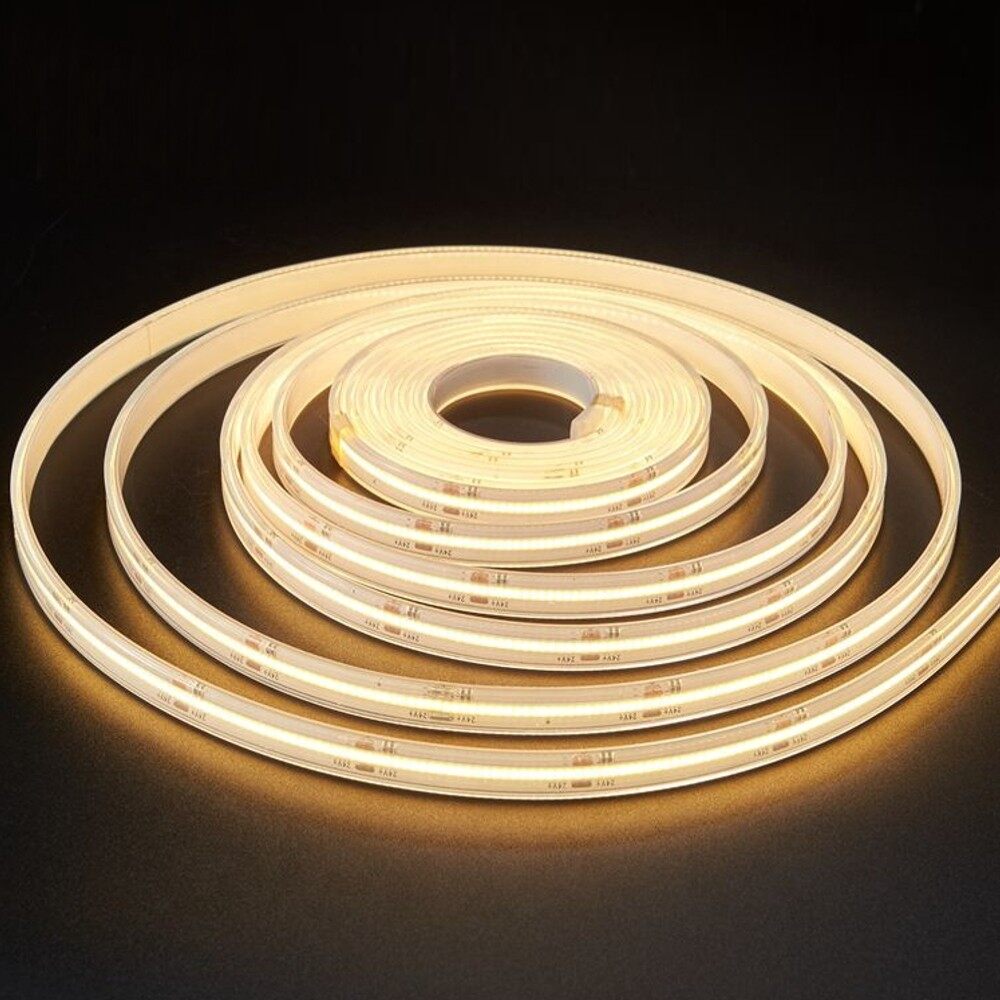
Ordering custom COB LED strips for international projects requires more than selecting a product from a catalog. Voltage compatibility, color temperature precision, color rendering accuracy, and lead time planning directly affect installation success and client satisfaction. This guide breaks down the customization process into actionable technical specifications that overseas engineering merchants need to verify before placing orders.
Voltage Configuration: Matching Regional Standards
COB LED strips operate at specific voltage levels, and selecting the wrong specification creates installation failures or safety hazards. The three standard voltage options are 12V DC, 24V DC, and 220V AC, each serving different application scenarios.
Low-voltage options (12V and 24V DC) dominate commercial and residential installations because they offer safer handling, easier cutting at short intervals, and compatibility with standard dimming systems. The choice between 12V and 24V depends on run length and power requirements. A 24V system carries the same wattage at half the current of a 12V system, reducing voltage drop across longer runs. For installations exceeding 5 meters in continuous length, 24V configuration minimizes brightness degradation at the far end of the strip.
High-voltage 220V AC strips serve outdoor architectural lighting and long-run applications where transformer placement is impractical. These strips connect directly to mains power through a rectifier, eliminating the need for multiple power supplies. However, they cut only at 1-meter intervals and require certified electrical installation by licensed professionals.
Overseas merchants must confirm the destination country's standard voltage and frequency before ordering. Regions using 110-120V mains (North America, parts of South America and Japan) require different power supply specifications than 220-240V regions (Europe, Asia, Africa, Australia). Specifying the correct input voltage range on power supplies prevents equipment damage and warranty disputes.
Color Temperature: Precision Beyond Warm and Cool
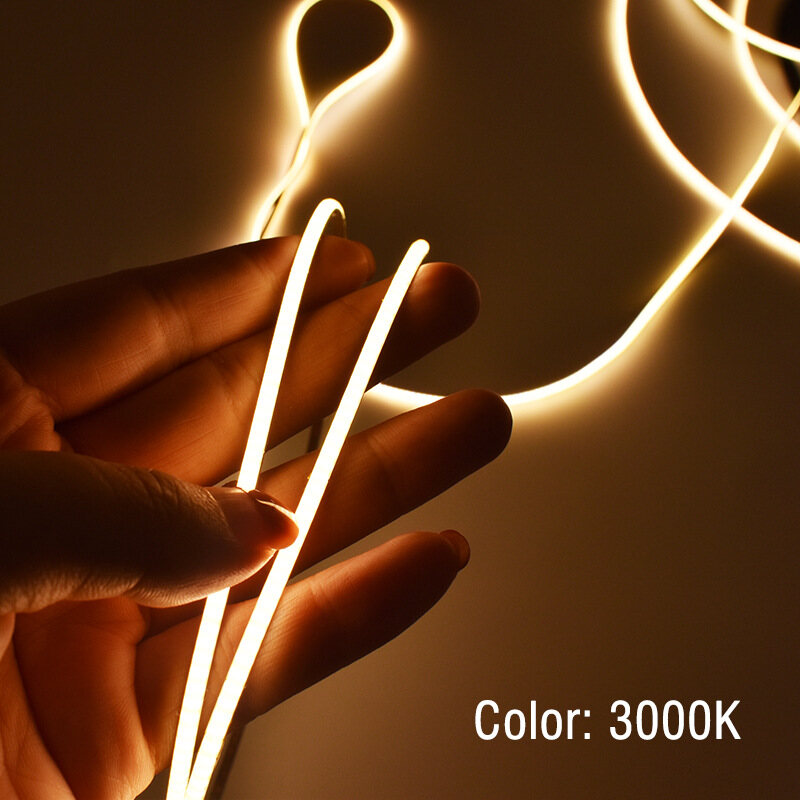
Color temperature, measured in Kelvin (K), determines the visual warmth or coolness of white light. COB LED strips are available in fixed color temperatures (2700K, 3000K, 4000K, 5000K, 6500K) or adjustable tunable white versions spanning 2700K to 6500K.
Fixed color temperature strips deliver consistent output at lower cost and simpler control. The selection depends on application context: 2700K-3000K creates warm ambiance for hospitality and residential spaces; 4000K provides neutral white light suitable for retail displays and office environments; 5000K-6500K produces cool daylight tones for task lighting, industrial settings, and outdoor security applications.
Tunable white strips integrate warm and cool LED chips in a single strip, allowing dynamic adjustment through compatible controllers. These serve circadian lighting systems in healthcare facilities, adaptive retail environments, and smart building installations where light quality changes throughout the day. The trade-off is higher cost per meter and the requirement for specific control protocols (DALI, DMX, or proprietary wireless systems).
Merchants should request chromaticity coordinate data (CIE 1931 x,y values) alongside Kelvin specifications. Two strips both rated at 4000K can exhibit visible color differences if their chromaticity coordinates fall outside the same MacAdam ellipse step. Specifying ≤3 SDCM (Standard Deviation of Color Matching) ensures batch-to-batch consistency across large projects.
CRI: The Metric That Defines Light Quality
Color Rendering Index (CRI) measures how accurately a light source reproduces object colors compared to natural reference illumination. The scale runs from 0 to 100, with higher values indicating more faithful color reproduction.
For COB LED strips, CRI thresholds correlate with application requirements. CRI ≥80 serves general architectural and ambient lighting where color accuracy is secondary. CRI ≥90 is the standard for retail environments, art galleries, hospitality spaces, and residential applications where product appearance and visual comfort matter. CRI ≥95 is mandatory for photography studios, medical examination areas, textile and paint matching facilities, and premium retail where color discrimination is critical.
High-CRI strips achieve accuracy through phosphor formulation optimization and spectral engineering. The manufacturing cost increases with CRI level because premium phosphors and tighter binning tolerances reduce production yield. Merchants should understand that CRI 95 strips cost 20-30% more than CRI 80 equivalents, but the investment prevents client complaints about "colors looking wrong" under installed lighting.
Request spectral power distribution (SPD) graphs from suppliers when specifying high-CRI products. The graph reveals whether the strip achieves high CRI through balanced full-spectrum output or through narrow-band spikes that inflate the Ra number while failing to render certain colors accurately.

Sampling Cycle: Planning for Iteration and Approval
Custom COB LED strip orders typically follow a sampling process before mass production. Understanding this timeline prevents project delays and misaligned expectations.
The sampling cycle consists of three phases. Phase 1 involves specification confirmation: voltage, wattage per meter, color temperature, CRI, IP rating, length per reel, and any special requirements (bending radius, adhesive type, connector style). This phase takes 1-2 business days for technical review and quotation.
Phase 2 covers sample production, typically 5-7 working days for standard specifications and 10-15 working days for custom configurations (non-standard voltage, specialized IP ratings, unique PCB layouts). Samples ship via express courier (3-7 days internationally depending on destination and customs clearance).
Phase 3 is client evaluation and feedback. Engineering merchants should allocate 1-2 weeks for on-site testing, including brightness verification with lux meters, color temperature validation with spectrometers, and compatibility checks with existing control systems.
Total sampling cycle from initial inquiry to approval for mass production averages 3-4 weeks. Merchants managing projects with fixed installation deadlines must initiate the sampling process at least 6-8 weeks before the required delivery date, accounting for mass production lead time (15-25 working days depending on order quantity) and international shipping.
Pre-Order Checklist for Engineering Merchants
Before placing a bulk order, verify these technical and commercial parameters:
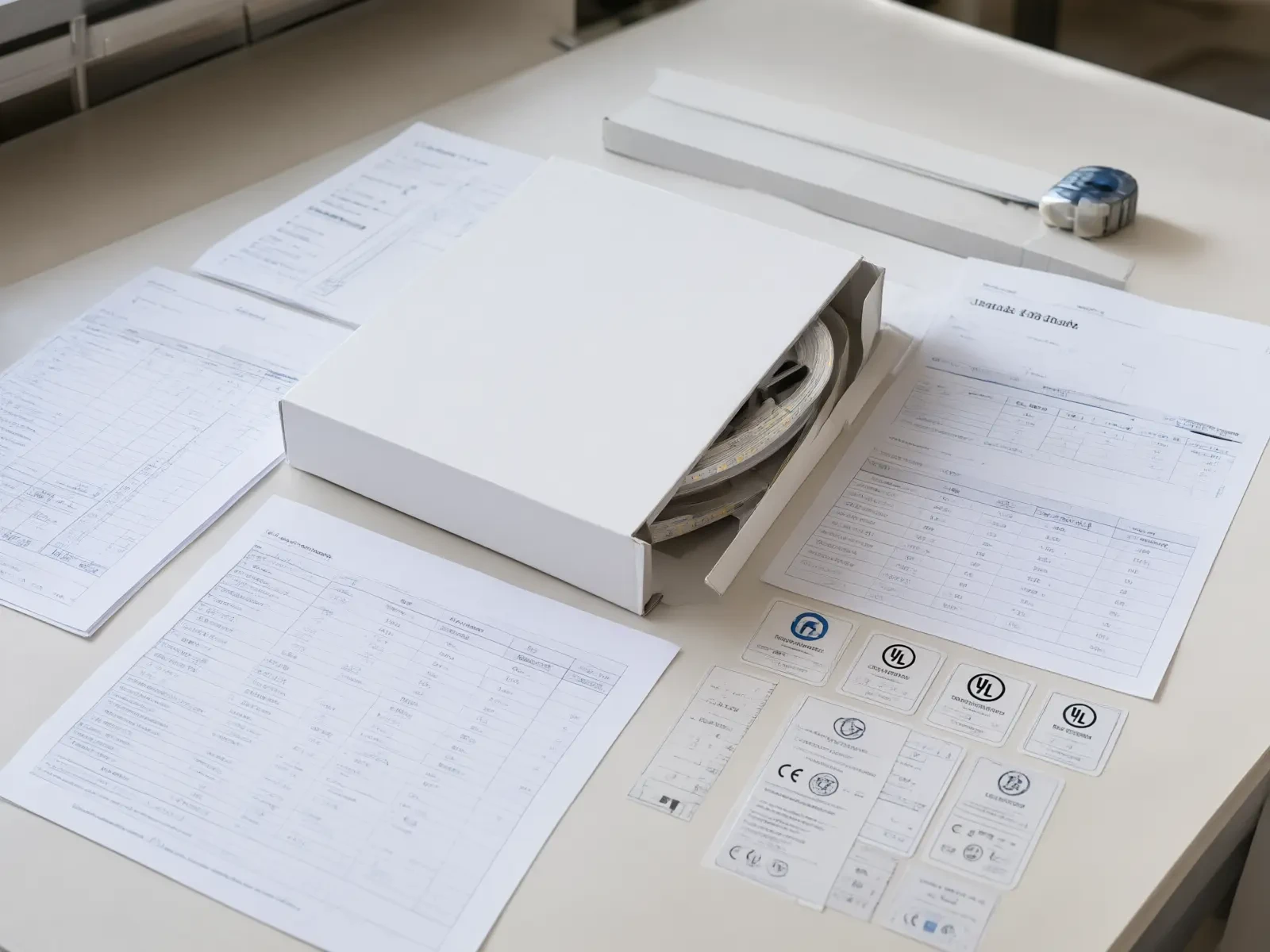
Confirm destination country electrical codes and certification requirements. CE marking is mandatory for European Union markets; UL listing is required for North American commercial installations; SAA certification applies to Australian projects. Non-compliant products face customs rejection or legal liability.
Specify IP rating based on installation environment. IP20 suits indoor dry locations; IP65 handles indoor humidity and occasional splashing; IP67 withstands temporary water immersion for outdoor landscape lighting; IP68 enables continuous underwater installation in pools and fountains.
Request batch consistency guarantees. Large projects spanning multiple installation zones require strips from the same production batch to avoid visible color variation. Specify single-batch supply in the purchase order.
Clarify warranty terms and failure replacement protocols. Standard warranty covers 3-5 years for LED degradation (L70 lifetime) and manufacturing defects. Confirm whether replacement involves full reel exchange or on-site technical support.
Establish clear communication channels for technical support during installation. Complex projects benefit from pre-installation video consultations where suppliers review wiring diagrams, transformer sizing calculations, and control system integration.
Conclusion
COB LED strip customization succeeds when engineering merchants treat specifications as engineering parameters rather than marketing claims. Voltage configuration must match regional electrical standards. Color temperature selection should align with application psychology and visual comfort research. CRI requirements must reflect actual color discrimination needs, not just cost optimization. Sampling cycles require realistic timeline planning that accounts for iteration and approval.
Merchants who verify these technical details before ordering reduce installation failures, minimize client complaints, and build reputations for delivering reliable lighting solutions. The customization process is not a barrier to entry but a quality control mechanism that separates professional suppliers from commodity vendors.
Contact
Tell us your project requirements — voltage, pixel density, color temperature and quantity. Our engineering team will propose a matching solution.
- +86 138 2520 5052
- jason@newstarleds.com
- 7/9F 1Building Xinhuiyuan Chanyeyuan, Xinyuan 1st Road, Dalang Town Dongguan 523770 GuangDong China
Request a Quotation
Send your specification through the inquiry form and receive an engineering reply within 24 hours on working days.
Open Inquiry Form500+
Available models
60+
Export countries